
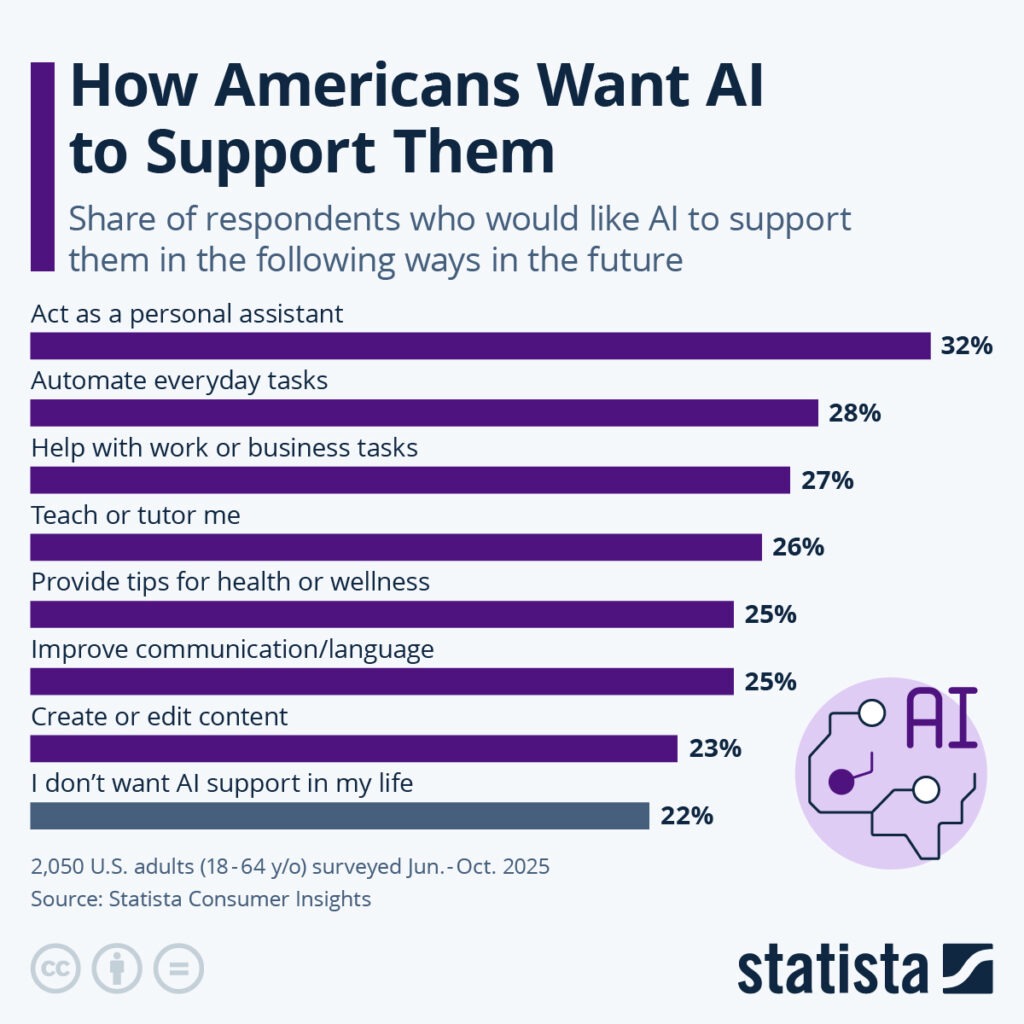
Artificial Intelligence (AI) has become a staple of the news. From ChatGPT writing cover letters to algorithms creating art, the possibilities seem endless. But that it can, does not mean that we also want That AI will take over everything for us. Recent data from Statista shows that there is a clear dividing line: we are quite willing to help, but we don't want to lose our humanity.
Americans - as is often the case with new technology - are the testing ground for the rest of the world. A recent survey shows that they embrace AI primarily as a digital assistant, but absolutely not as a substitute for human connection or creativity.
The ideal ‘rule snob’
What makes us happy? Mainly efficiency. The vast majority of those surveyed see AI as the perfect tool to take boring, time-consuming jobs off their hands. Think:
- Information search: Instead of spending hours Googling, have AI list the best options for a new hoover or holiday destination.
- Planning and organisation: managing calendars, booking tickets or creating an itinerary.
- Translation and learning: AI as interpreter or teacher to master new skills.
In short: as long as AI acts as a super-efficient secretary that makes our lives easier, the lights are on green. It saves time, and time is money.
The limit: Stay away from our creativity (and our children)
However, acceptance plummets dramatically as soon as it becomes personal. The data shows that there is a lot of resistance to AI in roles that require empathy, creativity or human insight.
- Creative writing: Getting a script, a novel or even a personal speech written by AI? Most people think this is a bridge too far. It feels like ‘cheating’ and lacks human soul.
- Education and care: Using AI as a babysitter or for relationship counselling is for many an absolute no-go.
- Medical decisions: While AI is good at supporting diagnoses, we want a flesh-and-blood human to make the final decision.
The conclusion from America is clear: AI should support us (support), not replace us (replace).
And what about in the Netherlands? The down-to-earth polder analysis
Although the figures come from America, we can cautiously predict how this will land in the Netherlands. The Dutch are known as early adopters of technology, but we are also critical and concerned about our privacy.
1. The Dutch efficiency drive The Netherlands is a champion of efficiency. We love sending Tikkies, online banking and arranging everything digitally. The Dutch are expected to embrace AI even faster for administrative tasks than Americans. Do we hate filing tax returns or filling in forms? If AI can take over that (flawlessly), the down-to-earth Dutchman will say, “Gladly, then I'll have time for nicer things.”
2. Directness vs AI politeness Where it can clash is in our communication. The Dutch are known for their directness. The current generation of AI chatbots is often trained on American politeness (lots of “apologies”, “I understand”, “how annoying”). A Dutchman who has an AI write a business e-mail is likely to find the text too ‘fluffy’, too long and too excessive. We want to the point communication. So the acceptance of AI for writing here will depend on how well the AI can mimic our ‘blunt’ directness.
3. The privacy paradox In Europe, and certainly in the Netherlands, we are much stricter on privacy (AVG) than in the US. Whereas an American might more easily throw his medical data into an app for advice, the Dutchman is more likely to ask: “Where does that data go? Is my insurer watching?”. In the Netherlands, trust in AI as an ‘assistant’ will hinge on the guarantee that our data is safe.
4. The human touch As in the US figures, we are also likely to draw the line at being human. In a country where we have ‘sociability’ as a core value, you do not let an AI write a Sinterklaas poem (okay, maybe as a stopgap solution) and certainly not send a condolence message. The appreciation of ‘real’ contact, precisely because of the rise of AI, will only increase.
Conclusion
The trend is universal: we want to use AI as a high-tech toolbox, not as a new species taking our place. For the Netherlands, if it saves us time and ‘no fuss’, we are fans. But as soon as it affects our privacy or the human warmth disappears, we apply the brakes.


 Nederlands
  English (UK)
  Español
  Deutsch
  Français
  Italiano